
Herne at Yule
The Wild Hunt is in the Air!

Greetings readers! Following is an expansion of a blog post from a few years ago. If you like, you can think of it as the Ghost of Blog Posts Past.
T’is the season of the Solstice. For reasons I am trying to understand, I associate this time of year with the figure of Herne the Hunter, who in turn is often associated with the Celtic horned god Cernunnos.
Let’s explore.
Herne in Literature
Herne is known as a legendary spirit who haunts the Windsor Woods in England. His earliest appearance in writing occurs in Shakespeare:
There is an old tale goes, that Herne the Hunter
(sometime a keeper here in Windsor Forest)
Doth all the winter-time, at still midnight
Walk round about an oak, with great ragg’d horns;- The Merry Wives of Windsor, Act 4, scene 4
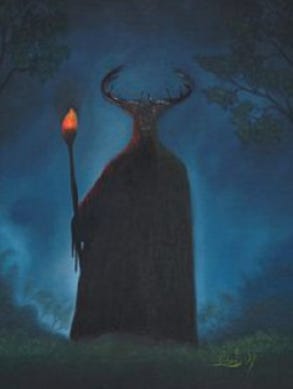
Later authors elaborated on the legend. Herne was said to be a gamekeeper from the time of Elizabeth I who committed some great offence and, as a result, hanged himself from that same oak tree. But as noted in Wikipedia 1:
There is little written evidence for Herne the Hunter before the 1840s, and the details of his original folk tale have been filtered through the various versions of Shakespeare’s The Merry Wives of Windsor.
Herne and Cernunnos
Because of his horns and his haunting of the forest, many writers have identified Herne with the ancient Celtic deity, Cernunnos (“The Horned One”).
Cernunnos’ name and image are found on the “Pillar of the Boatmen” discovered in Paris, France, and dating from the 1st Century CE.
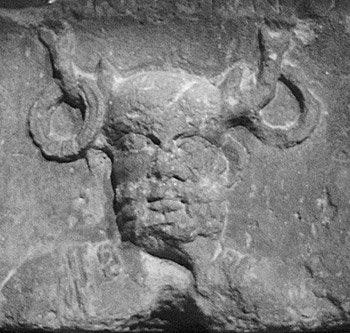
Again quoting Wikipedia:
Through the Pillar of the Boatmen, the name “Cernunnos” has been used to identify the members of an iconographic cluster, consisting of depictions of an antlered god (often aged and with crossed legs) associated with torcs, ram-horned (or ram-headed) serpents, symbols of fertility, and wild beasts (especially deer). The use of the name this way is common, though not uncontroversial.
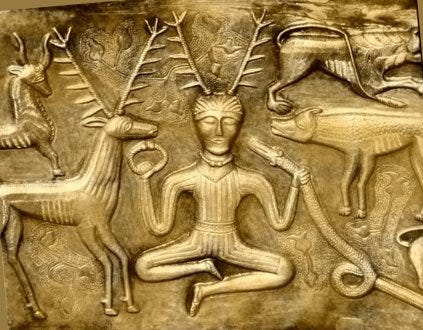
While interpretations of Cernunnos abound, he is often associated with Nature, fertility, and the wilds. Scholar Miranda Green identified him with the “Lord of the Animals” motif.
But to what degree can we identify Cernunnos with Herne? Twentieth-century authors R. Lowe Thompsen and Margaret Murray cite linguistic evidence to associate the two names.2 But later scholars find these arguments less than convincing.
Recent Incarnations
Both Herne and Cernunnos have lived on over the centuries and taken on many forms. In modern strains of neopaganism, especially Wicca, Herne and Cernunnos are used as names for “the Horned God”, thought to be a god of Nature and the embodiment of the turning year.
... the Horned God is a deity that is believed to be the equal to the Great Goddess and syncretizes various horned or antlered gods from various cultures. The name Cernunnos became associated with the Wiccan Horned God through the adoption of the writings of Margaret Murray.3
Herne also appears as a figure in popular culture, including novels, films, comics, and games. Speculative fiction authors such as Lloyd Alexander, Terry Pratchett, Susan Cooper, and Jim Butcher have all brought Herne to the page.4
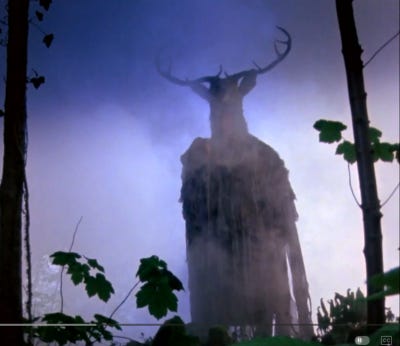
A personal favorite of mine is the 1980s TV series Robin of Sherwood, in which Herne is a spirit guide to Robin and calls him to become “the Hooded Man.”
Herne and Yule and the AI
So, both Herne and Cernunnos have fascinating and many-faceted histories. But with all of these sources and threads, I still wasn’t sure why I felt an association of Herne with the Yule Season.
Therefore, like any competent modern researcher, I asked an AI.
Question to Google: Is Herne the Hunter associated with Yule?
Answer: Yes, Herne the Hunter is strongly associated with Yule and the winter season, often seen as a manifestation of the ancient Horned God (like Cernunnos) leading the Wild Hunt during the longest nights to represent nature’s wild power, rebirth, and the return of light...
Ha Ha! Now we’re talking!
So, what is this Wild Hunt, you ask?
The legend of the Wild Hunt occurs across northern and eastern Europe. “Wild Hunts typically involve a chase led by a mythological figure escorted by a ghostly or supernatural group of hunters engaged in pursuit.”5
Depending on the version, the Wild Hunt may be a portent of death and disaster, or simply a sign of the turning of the year. If you are interested, this video gives an excellent survey.
Every country seems to have its own variation of the Wild Hunt (if not more than one). And, as noted in the Wikipedia article cited above, in Britain the Wild Hunt is led by Herne.
That same article also says that:
The role of Wotan’s Wild Hunt during the Yuletide period has been theorized to have influenced the development of the Dutch Christmas figure Sinterklaas, and by extension his American counterpart Santa Claus, in a variety of facets. These include his long white beard and his gray horse for nightly rides.
Herne at Yule
So! Herne, Cernunnos, Wotan, and Santa Claus—they can all be legitimately connected. And “Herne at Yule” is a thing! My thesis is defended!
As we have seen, many interpretations of these figures exist and may be considered equally valid.
My personal take is this: Whatever the ghostly and scary aspects of hauntings and the Wild Hunt, I think of Herne/Cernunnos as a god of Nature, lord of the forest and of wild creatures. Because it is Nature that feeds us, he is the provider of food and therefore of life. I think of him as the embodiment of desire with a capital D — the fire in the belly that drives us all to live.
Inspired by that perspective, I wrote this wee poem:
Herne
The spirit worlds are deep and high,
In firelight and smoky air,
In sparkling stream and cave and sky,
And Herne is there.
The forest seethes in emerald light,
In tusk of boar and snout of deer;
A shaman dances in the night,
And Herne is near.
And cities race on wheels and fumes,
Computer screens where data burns,
Workers scurry through the rooms:
So many Hernes.
The human world leafs from the Tree
Because we hunters chase and yearn;
Our hunger makes the world to be,
And so lives Herne.
Wherever you are in the world and whichever holidays you may celebrate, I wish a Happy Solstice and, for the year ahead, Good Hunting!
https://en.wikipedia.org/wiki/Herne_the_Hunter
https://en.wikipedia.org/wiki/Herne_the_Hunter. Thomspen": The History of the Devil – The Horned God of the West 1929. Murray, The God of the Witches, 1933.
https://en.wikipedia.org/wiki/Cernunnos
https://en.wikipedia.org/wiki/Herne_the_Hunter
https://en.wikipedia.org/wiki/Wild_Hunt
What you write about is ALWAYS so interesting! GREETINGS to you too!!
The Wild Hunt! Love me some Norse Mythology. Great wee little poem, too.